The Hidden Saboteur of Running Performance
Most runners focus on building endurance and speed, but according to an experienced Pilates instructor, there's a common postural imbalance that's secretly holding back their performance and increasing injury risk. The culprit? Anterior pelvic tilt—a condition caused by weak glutes, abs, and hamstrings paired with overactive hip flexors.
This postural misalignment doesn't just affect how you look; it fundamentally changes how your body moves during running, creating inefficiencies that can lead to pain and injury over time. The good news is that targeted Pilates exercises can help restore proper pelvic alignment and improve neuromuscular balance.
Understanding Anterior Pelvic Tilt
Anterior pelvic tilt occurs when the pelvis rotates forward, creating an exaggerated arch in the lower back. This postural deviation stems from muscle imbalances that are all too common in modern life and running training patterns.
The problem develops when certain muscle groups become weak—specifically the glutes, abdominals, and hamstrings—while others become overactive, particularly the hip flexors. This imbalance creates a cascade of compensations throughout the body that can impact running efficiency and increase the likelihood of injury.
For runners, this postural issue represents more than just aesthetics. It's a performance hack waiting to be unlocked and a key component of injury prevention that many athletes overlook in favor of more traditional training methods.
The Pilates Solution: Three Targeted Moves
According to reports, the instructor prescribes three specific Pilates exercises that target the root cause of anterior pelvic tilt. These moves work together to strengthen weak muscles and restore proper neuromuscular coordination.
Glute Bridge March
The first exercise focuses on activating and strengthening the glutes—muscles that are often underactive in runners despite their crucial role in propulsion and stability. The glute bridge march combines the traditional bridge position with alternating leg lifts to challenge stability and coordination.
Perform this exercise for 45 seconds of work followed by 15 seconds of rest. The marching component adds a dynamic element that mimics the single-leg stance phase of running while maintaining proper pelvic alignment.
Dead Bug
The dead bug exercise targets the deep core muscles and teaches proper coordination between the abs and hip flexors. This movement is particularly valuable for runners because it trains the core to maintain stability while the limbs move independently—a skill directly applicable to running mechanics.
Like the glute bridge march, perform the dead bug for 45 seconds of work with 15 seconds of rest. The exercise challenges the nervous system to maintain a neutral spine position while coordinating opposite arm and leg movements.
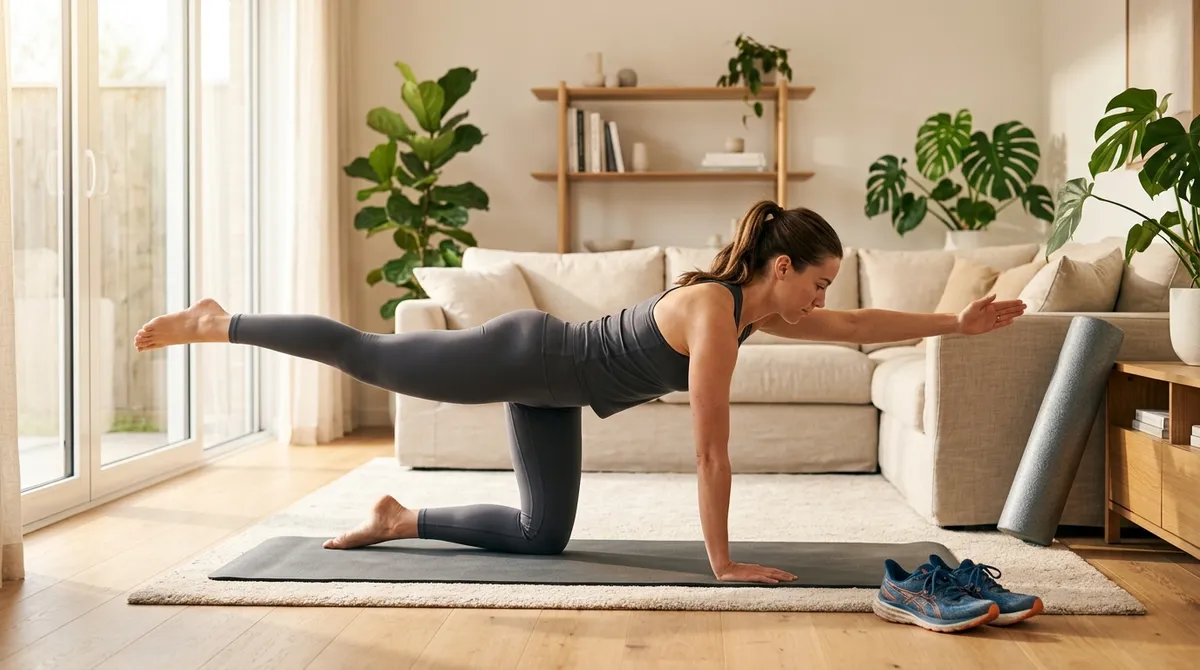
Quadruped Superman
The final exercise in the sequence, also known as the superman, strengthens the posterior chain including the hamstrings, glutes, and back extensors. This movement helps counteract the forward pelvic position by strengthening the muscles responsible for posterior pelvic tilt.
Follow the same timing protocol: 45 seconds of work followed by 15 seconds of rest. The quadruped position provides a stable base while challenging the back-body muscles to work against gravity.
Beyond Traditional Running Training
This approach represents a shift from traditional running training that often focuses primarily on cardiovascular fitness and leg strength. By incorporating Pilates principles, runners can address the neuromuscular coordination aspects of performance that are often overlooked.
The beauty of these exercises lies in their accessibility—they can be performed at home without special equipment, making them an easy addition to any runner's routine. The focus on corrective movement patterns rather than just strength building sets this approach apart from conventional cross-training methods.
The Performance Connection
Addressing anterior pelvic tilt isn't just about injury prevention; it's about unlocking better running performance. When the pelvis is properly aligned, the body can generate and transfer force more efficiently, potentially leading to faster times and less fatigue.
The instructor's approach bridges the gap between running training and corrective strength work, providing runners with a specific, science-backed solution to a common problem. By targeting the root cause of postural imbalances rather than just symptoms, these exercises offer a pathway to both better performance and long-term joint health.
For runners constantly seeking ways to improve their efficiency and reduce injury risk, these three Pilates-inspired moves provide a targeted solution to one of the most common yet overlooked issues in the running community.